
When living or working in Japan, people often hear that both a visa and a status of residence are important.
In daily conversations, it is common to hear phrases such as “I need to renew my visa,” “I don’t have a working visa,” or “My visa was not approved.” In most everyday situations, people rarely think about the exact difference between these two terms—and often, not knowing the difference does not cause major problems.
However, visa and status of residence are two clearly different concepts. Understanding the distinction will help you choose the correct procedures, avoid mistakes, and navigate Japan’s immigration system more confidently.
This guide explains their differences in a simple and practical way, especially for people coming to Japan for the first time or for employers who work with foreign nationals.
Who This Article Is For
- Foreign nationals planning to live in Japan for the first time
- Companies or organizations preparing to hire foreign employees
- Anyone who feels confused when talking about “visas”
Understanding the Difference Between a “Visa” and a “Status of Residence”
Many online resources—and even everyday conversations—use “visa” and “status of residence” as if they were the same:
“Visa = Status of Residence.”
In reality, professionals sometimes also adopt this simplified usage, as long as the meaning is clear to both parties. The term status of residence(Zairyu-shikaku:在留資格) can sound technical even for Japanese speakers, and for learners of Japanese it can be even more difficult to grasp.
But strictly speaking:
**A visa is needed once when entering Japan.
A status of residence is required throughout your stay in Japan.**
For example, if you ask a convenience store clerk, “What is your visa?” most will answer, “A student visa.”
The accurate answer should be:
- Status of residence: Student
But because “visa” is more widely understood, people commonly use that word instead.
Why are the definitions and actual usage different?
To understand this, let’s look at each term more carefully.
What Is a Visa (査証)?
A visa is essentially an “entry permit”
The official Japanese term for a visa is 査証 (shashō).
According to the Ministry of Foreign Affairs:
“A visa is one of the requirements for landing in Japan as provided by the Immigration Control and Refugee Recognition Act. It does not guarantee entry into Japan. Visas are issued at Japanese embassies and consulates abroad. They cannot be obtained at the time of arrival or while staying in Japan.”
This explanation can feel difficult to understand.
The Immigration Services Agency (ISA) further explains:
“A visa confirms that the passport is valid and recommends that the foreign national should not be refused entry based on the conditions written on the visa.”
This is easier to understand.
Putting these explanations together:
A visa serves as a type of “pre-entry permission” issued outside Japan.
A visa is used only once—upon entry
If a visa is like an entry permit, it makes sense that it is needed only once, at the moment of entering Japan.
It must be issued before arrival, which is why applicants must go to a Japanese embassy or consulate abroad to obtain it.
Once you present the visa at immigration, and the immigration officer approves your landing, the visa has served its purpose.
This is why the phrase “I need to renew my visa” is technically incorrect for people already living in Japan.
What Is a Status of Residence(Zairyu-Shikaku:在留資格)?
A status of residence defines the activities and conditions under which you may stay in Japan.
The Immigration Services Agency states:
“A status of residence is a legal category that defines the activities a foreign national is permitted to engage in while residing in Japan, or the personal status or position that allows residence. There are currently 38 types of status of residence.”
(As of October 2025)
Thinking about the term itself:
- 在留 (zairyū) = to reside / stay in Japan
- 資格 (shikaku) = qualification / requirements
So, a status of residence organizes and clarifies what a foreign national is permitted to do while staying in Japan.
A status of residence is tied to both the purpose of stay and the period of stay.
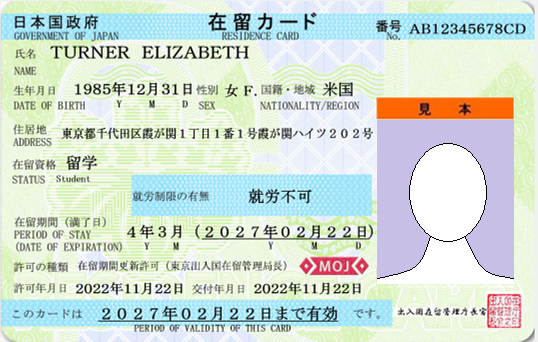
The sample residence card provided by the ISA shows:
- Status of Residence: Student
- Period of Stay: For example, 4 years and 3 months, until February 22, 2027
This means the person is allowed to live in Japan for the purpose of studying and for a specific period.
If the person instead works full-time for a company, that activity would fall outside the permitted scope of the “Student” status.
In short:
A status of residence is a combination of your permitted activities and your approved length of stay.
Why There Are “Certification,” “Change,” and “Extension” Procedures
What many people casually call “visa applications” generally fall into three categories:
- Application for Certificate of Eligibility (COE) – Certification
- Application for Change of Status of Residence – Change
- Application for Extension of Period of Stay – Extension
Once you understand the difference between visa and status of residence, these three procedures make perfect sense:
- Certification (COE):
Pre-screening your intended activities before entering Japan, so that a suitable status of residence can be granted upon arrival. - Change:
Changing your status of residence because your job or lifestyle has changed. - Extension:
Extending your stay under the same status of residence when the expiration date approaches.
There is no such procedure as “visa change” or “visa renewal” in Japan’s immigration system.
People use these phrases informally, but they refer to changing or extending a status of residence.
Communicating Clearly by Distinguishing Between “Visa” and “Status of Residence”
Both a visa and a status of residence are essential for coming to Japan and building your life here.
However:
- A visa = permission to enter Japan
- A status of residence = conditions for staying in Japan
Once you understand this difference, the required procedures and documents become much clearer.
This knowledge is important not only for foreign nationals, but also for employers, schools, and anyone supporting people from overseas.
We hope this guide helps you communicate accurately and proceed with confidence.
References
・Ministry of Foreign Affairs – Visa Information:https://www.mofa.go.jp/mofaj/toko/visa/
・Immigration Services Agency – Immigration / Residence Q&A:https://www.moj.go.jp/isa/immigration/faq/kanri_qa.html
・Immigration Services Agency – About the Residence Card:https://www.moj.go.jp/isa/applications/procedures/whatzairyu_00001.html

Contact Us
We welcome your inquiry. We usually reply to you within 2 hours (in our business hours)