
For foreign nationals living in Japan, companies that employ foreign workers, and people who plan to live in Japan with a foreign partner, one of the biggest concerns is how long it will take to receive the result of a status of residence application.
Depending on the type of status of residence being applied for and the workload of the regional Immigration Services Bureau handling the application, processing can sometimes take six months or longer. As a result, many applicants and employers find it difficult to plan when they can come to Japan or start working.
In this article, we explain how immigration examinations are conducted, what affects processing time, and what kind of timeline you can realistically expect—based on an analysis of official data published by the Immigration Services Agency of Japan (ISA).
Who This Article Is For
- Foreign nationals who have already submitted a status of residence application and are anxious because the result has not arrived
- Employers who want to know when a foreign employee will be able to start working
- Japanese spouses who plan to begin living in Japan with a foreign partner who is currently overseas
The Examination Process Until a Result Is Issued
Basic Flow of Immigration Examination
In general, status of residence applications are examined in the following steps.
① Formal Examination (Document Check)
Once an application is submitted, immigration first checks whether all required documents have been submitted and whether there are any deficiencies or errors.
If you apply in person at a regional Immigration Services Bureau, staff usually check the documents on the spot. For every type of status of residence, the Immigration Services Agency publishes an official document checklist on its website, so applicants should carefully confirm that nothing is missing before submission.
For online applications, all documents are uploaded as a single data set, and there is no immediate confirmation at the time of submission. If documents are missing, immigration will usually request additional materials later. However, if the deficiencies are serious, the application itself may be rejected, so extra care is required.
② Substantive Examination (Content Review)
If there are no formal deficiencies, immigration proceeds to examine the substance of the application.
At this stage, the following three points are especially important:
- Status eligibility: Whether the applicant’s intended activities fall under one of the legally defined statuses of residence
- Landing criteria compliance: Whether the applicant meets the specific requirements set for that status of residence
- Reasonableness (appropriateness): Whether there are sufficient reasons to consider the applicant’s stay in Japan appropriate
These points involve legal interpretation, so we will explain them in more detail in a separate article.
During the substantive examination, immigration assesses whether the submitted documents sufficiently explain and support these three points, and whether the applicant’s background—such as education and work history—matches the status of residence being applied for.
Because every application is different, each case is reviewed individually and carefully. Applications that require many supporting documents, or where eligibility is difficult to assess using objective criteria, naturally take longer. In addition, since the number of immigration officers is limited, processing times increase when applications concentrate in certain periods.
When Additional Documents Are Requested
In most cases, requests for additional documents arise when deficiencies are found during the formal examination. However, they may also be requested during the substantive examination if immigration has doubts or questions about the submitted materials.
Until the additional documents are submitted, the examination is effectively put on hold, which lengthens the overall processing time. Preparing additional documents often takes time, so minimizing the likelihood of such requests is crucial for obtaining a faster result.
That said, receiving a request for additional documents also means that the examination is actively progressing. If you receive such a request, do not panic—responding accurately and promptly will help prevent further delays.
What Is the “Status of Residence Processing Period”?
Officially Published Processing Periods by the Immigration
The “status of residence processing period” is an official dataset published on the Immigration Services Agency’s website. It summarizes the average number of days required for immigration processing at regional Immigration Services Bureaus nationwide.
For all statuses of residence except “Diplomatic” and “Official,” the data covers:
- Applications for a Certificate of Eligibility (COE)
- Applications for Change of Status of Residence
- Applications for Extension of Period of Stay
The figures show the period from application to approval and do not include denied applications or withdrawn cases.
Until FY2017, the data was published quarterly. Since October 2024, it has been updated monthly, making it an increasingly important reference for estimating processing timelines.
Recent Trends Based on September 2025 Approved Cases
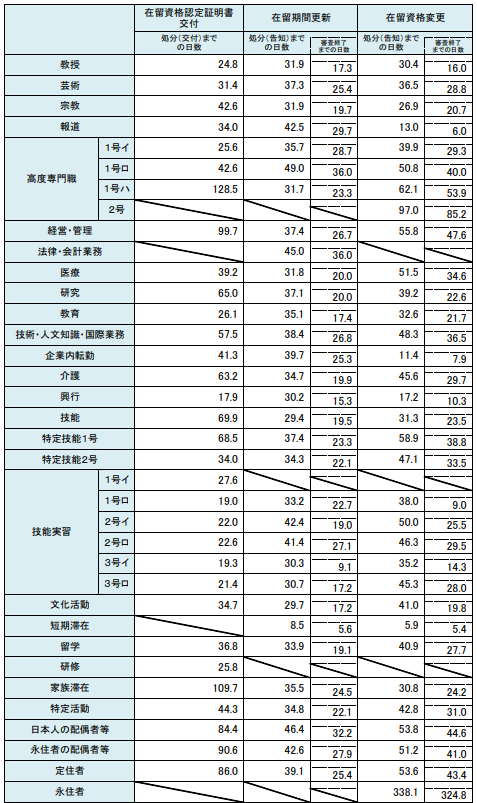
(https://www.moj.go.jp/isa/applications/resources/nyuukokukanri07_00140.html)
Application Types with Longer Processing Times:
COE > Change > Extension
Looking at the processing data for approvals issued in September 2025, applications for a Certificate of Eligibility consistently take the longest, followed by Change of Status, while Extensions of Period of Stay are processed the fastest.
This is because, in extension and change applications, immigration can evaluate the applicant’s past residence record in Japan, whereas COE applications involve first-time entry and therefore require more cautious examination.
Statuses with Longer Processing Times:
Family-Based Statuses and Business Manager
When comparing processing times by status of residence, “Dependent” stands out as exceeding 100 days in COE applications. Closely following are “Spouse or Child of Japanese National,” “Spouse or Child of Permanent Resident,” and “Long-Term Resident.”
These statuses share a common characteristic: they are family-based (status-related) statuses, granted based on personal relationships rather than specific work activities. Immigration carefully examines not only the applicant but also the stability and credibility of family relationships.
In particular, spousal statuses allow unrestricted employment, so immigration strictly verifies whether the marriage is genuine. This often requires multiple documents, and verifying their authenticity takes time.
The Business Manager status, although not a family-based status, also tends to take longer. This is because immigration must evaluate the stability, continuity, and credibility of the business, as well as its contribution to Japan, based on extensive documentation.
How Processing Times Are Determined for Work-Related Statuses
Processing times for work-related statuses vary widely depending on how clear the applicant’s activities are and how reliable the accepting organization is.
For example, in the “Entertainer” status, activities such as professional sports or performances are often clearly defined by contracts with established organizations, which shortens processing time. On the other hand, if activities are unclear or the organization lacks credibility, the COE may not be issued at all.
For statuses such as “Engineer / Specialist in Humanities / International Services” or “Specified Skilled Worker,” processing time can differ significantly depending on whether the employer is a public institution, a large listed company, or a small business hiring a foreign worker for the first time.
Because official statistics show averages, they do not reflect these individual differences.
Tips for Receiving a Faster Result
Can We Ask Immigration About Our Application Status?
When results take a long time, many applicants want to inquire about progress. However, individual status inquiries are generally not accepted.
Immigration authorities handle a large volume of applications, and responding to individual inquiries would delay overall processing. Legally, there is no obligation to disclose the status of ongoing examinations, so immigration offices uniformly decline such requests.
Tip ① Avoid Peak Application Seasons
Two periods are especially busy:
- Student visa season: Applications increase before April and October, when Japanese language schools begin new terms.
- Employment visa season: January to March is particularly busy as companies prepare for April hiring.
Applying outside these periods can help reduce waiting time.
Tip ② Stay Informed Using Multiple Sources
Official processing period data is highly reliable, but it represents averages. To better estimate your own case, it is helpful to look at similar recent cases, consult professional specialists such as Immigration specialists, or gather information through employer or community networks.
Conclusion: Apply with a Clear Understanding and Sufficient Time
Delays in status of residence applications often result from the need for careful document review and the characteristics of each status category.
While official processing period data is useful for understanding trends, individual cases may differ. To ensure a smoother process, it is essential to submit complete and accurate documents and minimize requests for additional materials.
Understanding how immigration examinations work can reduce anxiety and help you plan your move or employment in Japan more realistically. If you are unsure about preparation or timing, consulting an immigration professional can help you estimate processing time based on real cases and proceed with confidence.

Contact Us
We welcome your inquiry. We usually reply to you within 2 hours (in our business hours)