
Among the many statuses of residence in Japan, one of the most well-known is “Engineer / Specialist in Humanities / International Services,” commonly referred to as “Gijinkoku(技人国).”
When people think of a “work visa” in Japan, this status of residence is often what comes to mind.
However, the official name includes three different fields, and each of them can sound vague or difficult to understand at first glance. In this article, we provide a clear and practical explanation of what the Engineer / Specialist in Humanities / International Services status of residence is, who it is for, and what to watch out for when applying.
Who This Article Is For
- Foreign nationals seeking office-based jobs in Japan, such as IT engineers or business planning professionals
- HR managers and company representatives planning to hire foreign employees for office work
- International students in Japan who wish to find employment and work as full-time employees after graduation
What Is the “Engineer / Specialist in Humanities / International Services” Visa?
Definition and Scope of the Status of Residence
The Engineer / Specialist in Humanities / International Services status of residence is a work-related status for foreign nationals who engage in professional work requiring specialized knowledge.
Originally, this status was divided into two separate categories: “Engineer” and “Specialist in Humanities / International Services.”
Following revisions to Japan’s Immigration Control Act, these categories were merged on April 1, 2015, into the current unified status.
The purpose of this integration was to cover a broader range of professional occupations requiring specialized knowledge, regardless of whether the background is science-based or humanities-based. It also allows greater flexibility for internal transfers or job changes within the same company without requiring a change of status of residence.
Because the official name is long, it is commonly abbreviated in daily conversation as “Gijinkoku.”
This status is granted when a foreign national works for a Japanese company or organization in a role related to the field they studied at a university or vocational school. Typical examples include positions such as engineer, interpreter, trade specialist, marketing professional, or sales representative.
In general, it is intended for so-called “white-collar” office-based positions.
Difference from Other Work Visas: Non–Manual Labor Is Required
As noted above, Gijinkoku is a status designed for professional work utilizing specialized knowledge.
Therefore, immigration authorities require a clear connection between the applicant’s educational background and their actual job duties.
For this reason, the status cannot be used simply to fill labor shortages or to perform routine or manual tasks. The role must involve applying knowledge, making judgments, and contributing to business development or improvement through planning and execution.
This requirement is often summarized by stating that “simple labor is not permitted.”
By contrast, there are other statuses of residence that do allow manual labor, such as the “Specified Skilled Worker” status. These categories must be clearly distinguished and handled appropriately.
Eligibility Requirements and Required Documents
Educational Background and Relevance to Job Duties
To apply for the Engineer / Specialist in Humanities / International Services status, applicants must generally have graduated from a university or vocational school, and their job duties must be related to what they studied.
If the connection between education and job content is weak, the application may be denied.
Immigration authorities tend to apply more flexibility to applicants with a university degree, while vocational school graduates (holders of a “Diploma” in Japan) are expected to show a much closer and more direct connection.
For example, majoring in economics and working in sales, or majoring in information engineering and working in system development, are typically considered acceptable.
Even without formal educational qualifications, an application may still be possible if the applicant has at least 10 years of relevant professional experience (or 3 years for international services such as interpretation or language instruction).
Salary Level and Working Conditions
This status of residence is primarily intended for foreign nationals employed by companies or organizations in Japan.
As such, salaries and benefits must be equal to or higher than those provided to Japanese employees in comparable positions.
If the starting salary is unreasonably low, the application may be denied.
Working hours, benefits, and overall employment conditions are also subject to review.
These requirements are consistent with Japan’s principle of “equal pay for equal work,” and employers may not offer inferior treatment based on nationality. Ensuring fair conditions is not only a legal requirement but also important for long-term employee retention.
Stability and Credibility of the Employing Organization
Because this status assumes employment by a company or organization, the stability and reliability of the employer are carefully examined.
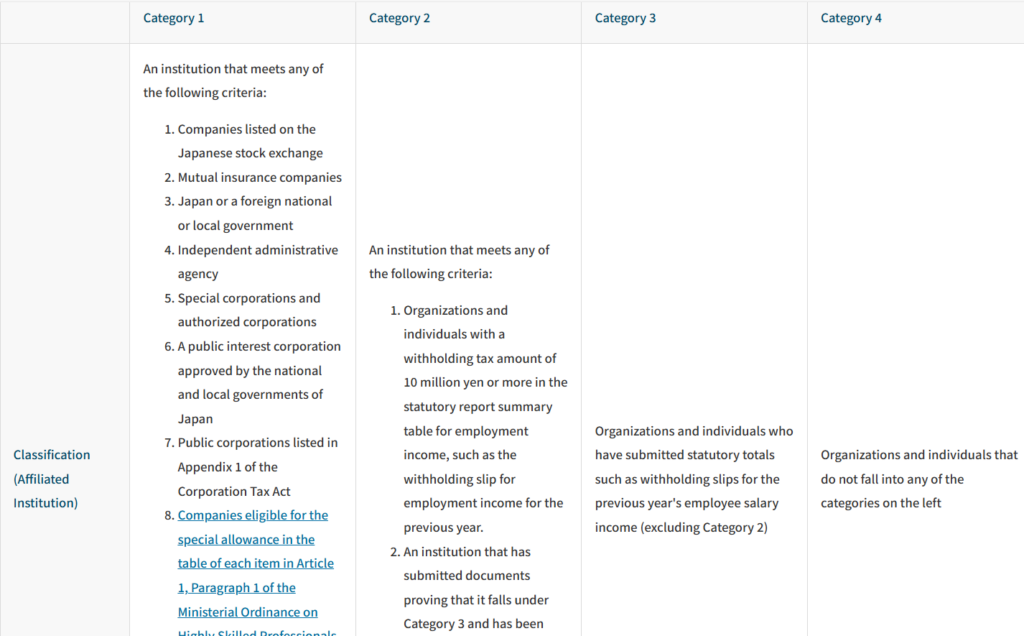
On the Immigration Services Agency’s website, employers are classified into several categories based on their size and credibility. Category 1 represents the highest level of trust, and companies in higher categories are required to submit fewer documents, often resulting in shorter processing times.
While Category 1 is generally limited to listed companies or public institutions, Category 2 is attainable for companies with a certain scale or those approved for the online residence application system.
Even within the same category, companies with a proven track record of properly employing foreign nationals or with a clear and reasonable purpose for hiring foreign staff are more likely to receive favorable consideration.
Common Reasons for Application Denial
Managing Foreign Workers with Other Work Statuses
In industries facing labor shortages, it is sometimes expected that a Gijinkoku visa holder will supervise or manage workers holding other statuses, such as Technical Intern Training or Specified Skilled Worker visas.
While sharing cultural or linguistic backgrounds may be beneficial, immigration authorities require clear evidence that job roles are distinct. The Gijinkoku holder must not engage in manual labor and should demonstrate genuine supervisory, planning, or management responsibilities beyond simple administrative tasks.
Working as a Dispatched (Temporary) Worker
Foreign nationals may also work under this status through temporary staffing agencies. While this can reduce administrative burden for host companies, the actual duties performed at the dispatch destination must strictly match the scope approved by immigration authorities.
For example, if a foreign language instructor is dispatched to a nursery school and also performs childcare duties, this would exceed the permitted scope and constitute unauthorized activity.
Both the dispatching agency and the host organization must ensure that the declared job duties and actual work content are fully aligned.
If Your Application Is Denied
If an application is denied, it is essential to review and retain the Notice of Reasons for Denial.
By visiting the regional immigration office with the notice, identification, passport, and copies of application documents, applicants may request an explanation of the reasons for denial.
Since many immigration offices allow this explanation only once, consulting with and being accompanied by a certified administrative procedures legal specialist (Gyoseishoshi) is advisable.
By understanding which requirements were deemed unmet and addressing those issues with additional documents or explanations, the chances of approval upon reapplication can be significantly improved.
Conclusion: Align Your Purpose with the Appropriate Status of Residence
The Engineer / Specialist in Humanities / International Services status is one of the most common work visas in Japan, and often the first option considered by both foreign nationals and employers.
However, as explained above, obtaining this status requires careful alignment between the applicant’s background, job duties, and employment conditions. Ensuring that all requirements are met and that activities remain within the permitted scope is essential.
Consulting with a qualified professional can help clarify whether the intended work is appropriate and ensure that the application process proceeds smoothly. If you have any concerns, seeking advice at an early stage is strongly recommended.

Contact Us
We welcome your inquiry. We usually reply to you within 2 hours (in our business hours)